

Short answer: missed-call text-back sends an automatic text to anyone whose call you didn’t pick up, usually within a minute or two. For a contractor who is on a roof, under a sink, or driving between jobs, it keeps the caller talking to you instead of dialing the next name on the list. Keep the message short, say who you are, give one next step, include an opt-out, and never text the same caller twice in a row.
Key Takeaways
- Most missed calls happen while you are doing paid work, not because nobody cares. Text-back covers the gap until you can call back.
- A good text-back has four parts: your business name, an apology, one next step (a booking link or “reply with what you need”), and an opt-out.
- Set quiet hours to fit your trade. A remodeler can wait until morning; a plumber with a burst-pipe caller probably can’t.
- Limit it to one text per caller per few hours, so a customer who calls three times doesn’t get three identical messages.
- Work out what a missed call is worth with your own numbers: missed calls × share that are new jobs × close rate × average job value.
What Is Missed-Call Text-Back?
When a call to your business number goes unanswered, rings busy, or drops, the phone system sends the caller a text from that same number. The caller sees a reply from the business they just tried to reach, not silence. They can book a time, text back what they need, or wait for your call, and the conversation is already started.
It is not an answering service and it doesn’t replace calling back. It buys you the time between the missed call and the moment you are off the ladder.
Why It Matters More for Contractors Than Most Businesses
An office business misses calls when the front desk is busy. A trades business misses calls because the owner is the front desk, and they are usually holding a tool. The calls you miss cluster around the times you are busiest: mid-job, on the drive between jobs, early mornings, evenings, and Saturdays.
Those are also the calls where the customer is ready to act. Someone calling about a leak, a dead AC unit, or a roof estimate before a storm is calling several companies, and the first one to respond usually gets the visit. A widely cited Harvard Business Review study of online sales leads found that companies that tried to contact a lead within an hour were nearly seven times as likely to qualify it as companies that waited longer. That study was about web inquiries, not phone calls, but the lesson carries over: the first business to reply has the advantage, and waiting even a few hours costs you.
What Should a Missed-Call Text Say?
Keep it under 160 characters if you can. That is one SMS segment, it reads in one glance, and it costs less to send. Every good text-back has the same four parts:
- Who you are. The caller may have dialed five companies. Put your business name first.
- A short apology. “Sorry we missed your call” is enough. Don’t explain why.
- One next step. A booking link, or “reply with what you need and we’ll call you back.” Not both, and not a menu.
- An opt-out. “Reply STOP to opt out.” It is expected, and in the US it is part of staying in good standing with the carriers.
Three Messages You Can Copy
Standard (estimate-driven trades: roofing, remodeling, painting):
Sorry we missed your call! This is Ridgeline Roofing. Book a free estimate here: [link]. Reply STOP to opt out.
Service and repair (plumbing, HVAC, electrical):
Hi, this is Northside Plumbing. Sorry we missed you, we’re on a job. Reply with what’s going on and we’ll call you back shortly. Reply STOP to opt out.
After hours:
Thanks for calling Northside Plumbing. We’re closed for the night. Book a time for tomorrow here: [link]. For an emergency, reply URGENT. Reply STOP to opt out.
Only use the “reply URGENT” line if someone actually watches for it. A promise you don’t keep at 11pm does more damage than no text at all.
What Is a Missed Call Worth to Your Business?
You don’t need an industry statistic for this. Your own numbers are better. Use this formula:
Missed calls per month × share that are new jobs × your close rate × your average job value = revenue at risk each month.
Here is a worked example with made-up numbers for a small HVAC shop. Swap in your own:
| Input | Example |
|---|---|
| Missed calls per month | 40 |
| Share that are new jobs (not existing customers, vendors, or spam) | 30% → 12 calls |
| Close rate when you do reach them | 40% → about 5 jobs |
| Average job value | $450 |
| Revenue at risk per month | about $2,160 |
Text-back won’t win back all of that. Some of those callers would have waited for you anyway. But if it keeps even one or two of those jobs a month from going to whoever answered first, it has paid for itself many times over. To get your own numbers, check your phone’s call log for a typical week and count the missed calls from numbers you don’t recognize.
Rules That Keep Text-Back From Backfiring
One Text Per Caller, Not One Per Call
Worried customers call more than once. If each missed call fires its own text, a caller who tries three times in ten minutes gets three identical messages, which looks like a broken robot. Limit it to one text per caller per few hours.
Set Quiet Hours That Fit Your Trade
Nobody wants a business text at 2am. Quiet hours hold texts overnight and send them in the morning. Choose the window based on your work: a remodeling company can safely hold texts until 8am, but an emergency plumber holding a burst-pipe caller’s text until morning has lost the job. If you take emergency work, use a short overnight window, or send the after-hours message above around the clock.
Register Your Number and Honor Opt-Outs
In the US, businesses texting from a regular local number have to register with the carriers through A2P 10DLC (brand plus campaign registration) before they can send at any real volume. Unregistered texts get filtered or blocked. Once you’re registered, treat STOP as final: one opt-out should end all automated texts to that number. Texting rules on consent vary by country and state, so check what applies to you.
Call Back Anyway
The text is a holding message, not the reply. Call back as soon as you can, and log it, so the next person who picks up the phone knows the customer has already been contacted.
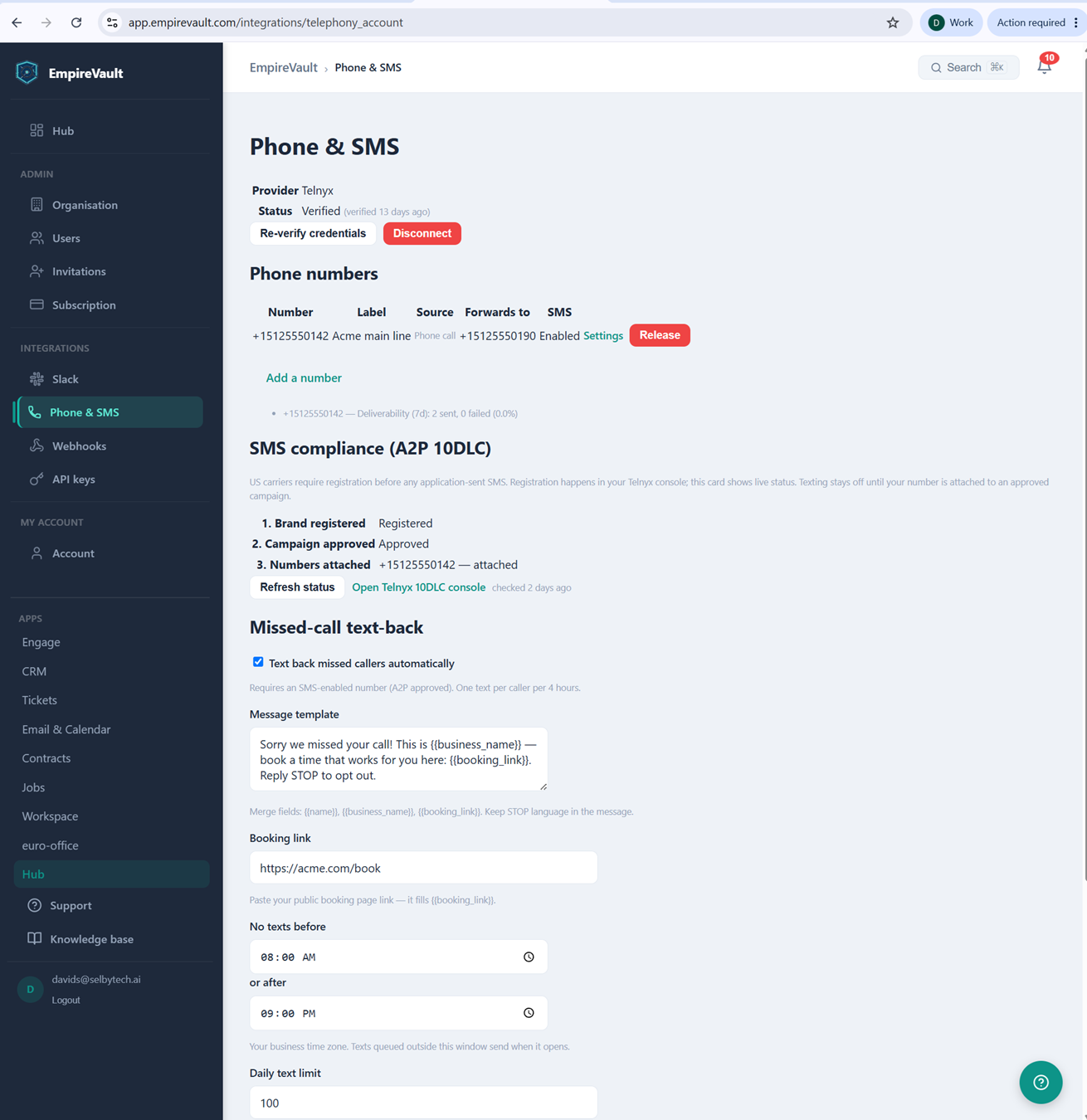
How Missed-Call Text-Back Works in EmpireVault
In EmpireVault, missed-call text-back is part of the Phone and SMS settings. You connect your own Twilio or Telnyx account, add a business number, and turn it on. When a call to that number goes unanswered or rings busy:
- The caller is added to the CRM as a lead, even if they hang up without leaving a voicemail.
- They get one text from your number, written from your template, with your business name, booking link, and their first name if they are already a contact.
- Each caller gets at most one text per number every four hours. Texts that fall inside your quiet hours are held and sent when quiet hours end, not dropped.
- If they leave a voicemail, it is transcribed and the lead is scored, so you can see which callback matters most.
- Their reply lands in the shared inbox next to email, so whoever calls back can see the whole thread.
The honest limits: you need your own Twilio or Telnyx account (your provider bills you directly for the number and messages), and US texting needs the 10DLC registration described above before it works at volume. EmpireVault is also not an answering service. Someone still has to call back. Phone and SMS is included in the same $39 per seat per month plan as everything else.
FAQ
What is missed-call text-back?
An automatic text sent to anyone whose call to your business goes unanswered. It tells the caller you got their call and gives them a next step, such as a booking link or a prompt to reply with what they need, until you can call back.
What should a missed-call text say?
Your business name, a short apology, one next step, and an opt-out line. For example: “Sorry we missed your call! This is Ridgeline Roofing. Book a free estimate here: [link]. Reply STOP to opt out.” Keep it under 160 characters so it arrives as a single text.
How quickly should the text go out?
Within a minute or two of the missed call, while the caller is still deciding whether to try someone else. Hold texts overnight with quiet hours, unless you take emergency calls.
Is missed-call text-back legal?
Texting someone who just called you is generally lower-risk than marketing texts, but rules still apply. In the US, register your number through A2P 10DLC, identify your business in every message, include an opt-out, and honor STOP immediately. Consent rules vary by country and state, so check what applies to you.
Does text-back replace answering the phone?
No. It keeps the caller from moving on while you finish the job in front of you. You still need to call back, and the faster you do, the more of those calls turn into work.